The Master Framework for Private Label Apparel Manufacturing: Semantic Sourcing, Procurement Trends & Factory Execution
A definitive B2B technical operational guide for fashion directors, retail buyers, global supply chain executives, and emerging brands seeking high-margin, compliant, and scalable OEM/ODM private label clothing production.
1. Navigating Modern Private Label Apparel Manufacturing in an AI-Driven Global Market
In the contemporary global trade ecosystem, Private Label Apparel Manufacturing has evolved far beyond basic contract sewing. As search engines and AI intent engines prioritize Information Gain, E-E-A-T (Experience, Expertise, Authoritativeness, Trustworthiness), and exact semantic matching, brand managers and enterprise procurement teams require deeper technical clarity. Global sourcing managers no longer ask generic queries like "where to make clothes." Instead, they prompt advanced search AI for specific engineering parameters: "How to calculate BOM for 100% combed cotton 220 GSM heavyweight tees," "ISO-certified garment factory in India with low MOQ private label capabilities," or "AQL 2.5 vs AQL 4.0 apparel inspection protocols for US import clearance."
To build a resilient clothing line or expand an enterprise corporate uniform program, brand owners must partner with apparel manufacturers that bridge the gap between creative design vision and industrial precision. Based in Gurgaon, Delhi NCR, Vihaan International operates at the nexus of high-end textile craftsmanship and modern factory management, helping domestic and international brands scale efficiently while protecting design integrity and margins.
Semantic Procurement Standard: Modern B2B buyers evaluate apparel partners not merely on price per unit, but on comprehensive Total Cost of Ownership (TCO). This includes fabric yield efficiency, pattern grading accuracy, international lab-test compliance (AATCC / ISO standards for colorfastness and shrinkage), and transparent supply chain documentation under FOB, CIF, or DDP terms.
2. Strategic Private Label Apparel Product Recommendations
Selecting the right product categories for your private label range determines your initial margin profile, inventory turnover rate, and brand positioning. At Vihaan International, we recommend structured product lines engineered for consumer longevity and high repeat purchase rates:
Women's Western Wear
Elevated contemporary silhouettes including tailored dresses, co-ord sets, oversized button-downs, trench coats, and denim waistcoats. Engineered for precision drape and luxury hand-feel.
Heavyweight Premium Tees & Polos
Structured street-style oversized t-shirts and mercerized cotton polo shirts designed for fashion retail brands and high-end executive corporate merchandise.
Corporate & Hospitality Uniforms
Bespoke tailored blazers, formal dress shirts, service aprons, and housekeeping attire. Built for rigorous commercial laundry durability and daily wear comfort.
To provide full technical clarity, the matrix below details technical specifications, recommended fabric blends, and lead-time schedules across our primary private label garment classifications:
| Product Classification | Fabric & Fiber Engineering | GSM Weight Range | Customization Options | Sample Lead Time | Bulk Production Time |
|---|---|---|---|---|---|
| Women's Fashion Dresses | 100% Rayon / Viscose / Modal / Silk Crepe | 120 – 180 GSM | Digital Print, Screen Print, Embroidery, Smocking | 7 – 10 Days | 15 – 20 Days |
| Women's Co-ord Sets | Pure Linen / Cotton-Linen Blend / Ribbed Knit | 160 – 240 GSM | Custom Fabric Dyeing, Logo Buttons, Private Tags | 7 – 10 Days | 15 – 22 Days |
| Streetwear Oversized Hoodies | 100% Combed Cotton French Terry / Fleece | 350 – 450 GSM | Puff Print, High-Density Embroidery, Custom Aglets | 7 – 10 Days | 18 – 25 Days |
| Corporate Formal Shirts | 60s/80s Superfine Compact Cotton / Easy-iron Poly-cotton | 110 – 150 GSM | Monogram Embroidery, Collar Stiffeners, Brand Labeling | 5 – 7 Days | 15 – 20 Days |
| Luxury Hospitality Blazers | Poly-Viscose Stretch Twill / Wool Touch Blends | 280 – 380 GSM | Bespoke Inner Lining, Custom Crest Buttons, Contrast Piping | 10 – 12 Days | 20 – 25 Days |
3. Future Procurement Trends in Private Label Garment Sourcing (2026–2030)
Global apparel procurement is undergoing a paradigm shift driven by geopolitical diversification, AI-boosted intent forecasting, demand volatile supply chains, and strict environmental regulations. B2B procurement leaders must align their sourcing roadmaps with four structural macro-trends:
A. The "India+1" Diversification & Nearshoring Balance
While Western fashion houses historically relied heavily on single-country manufacturing ecosystems, supply chain disruptions have highlighted the risk of over-concentration. India has emerged as the global leader for high-value apparel manufacturing due to its vertically integrated cotton ecosystem, skilled artisan workforce, advanced machinery infrastructure, and favorable international trade agreements. Vihaan International's strategic manufacturing hub in Gurgaon, adjacent to Indira Gandhi International Airport and major dry ports, gives international buyers an ideal logistics gateway with fast vessel transit times to Europe, the Americas, and the Middle East.
B. Micro-Batch Sourcing & Demand-Driven Replenishment
Traditional procurement required massive initial order volumes (5,000+ units per style), forcing brands to lock capital into unverified inventory and leading to markdowns. Modern procurement strategies utilize micro-batch manufacturing models—starting with low MOQs (200–500 units), testing market response through direct-to-consumer (D2C) channels or retail pop-ups, and rapidly executing 14-day re-orders for top-performing SKUs.
C. AI-Powered User Intent Sourcing & Predictive Trend Alignment
Fashion search engines and social buying algorithms now detect aesthetic trends in real-time. Procurement directors use AI data to source hyper-specific micro-trends (e.g., "heavyweight boxy drop-shoulder hoodies," "minimalist linen resort sets"). Vihaan International's rapid sampling laboratory translates digital mood boards and AI-generated renders into physical cut-and-sew prototypes within 7 working days.
D. Material Traceability & Circular Economics
International markets are tightening requirements for recycled yarns, organic cotton certification (GOTS), and chemical safety (OEKO-TEX Standard 100). Future-proof private label manufacturing requires full mill-to-garment transparency. Every fabric batch processed at our facility undergoes rigorous lab audits to guarantee zero harmful dyes, colorfastness through 50+ commercial wash cycles, and minimal wash shrinkage.
4. Industry Development Trends & Technological Innovations
The global garment manufacturing sector is moving from manual labor intensity toward technology-enabled precision manufacturing. Key innovations reshaping modern factories include:
Digital CAD Patterning & 3D Fitting Renders
Eliminating physical pattern paper through Optitex and Lectra digital pattern engineering software. Reduces fitting revisions by 60% and optimizes fabric marker yield to lower material cost per unit.
Precision Sewing Automation
Integration of JUKI computerized sewing automatons, automatic pocket setters, and programmable pattern sewers. Ensures stitch length consistency (±0.5 mm tolerance) across thousands of production units.
EU Digital Product Passport (DPP) Readiness
Preparing apparel brands for upcoming European regulations requiring full digital traceability of raw fiber origin, water usage metrics, and factory compliance certifications embedded via QR/NFC garment labels.
Eco-Friendly Garment Wash & Dyeing Systems
Transitioning to closed-loop water treatment systems, bio-enzyme washes for denim, and low-liquor dyeing technology that slashes chemical and water consumption during garment finishing.
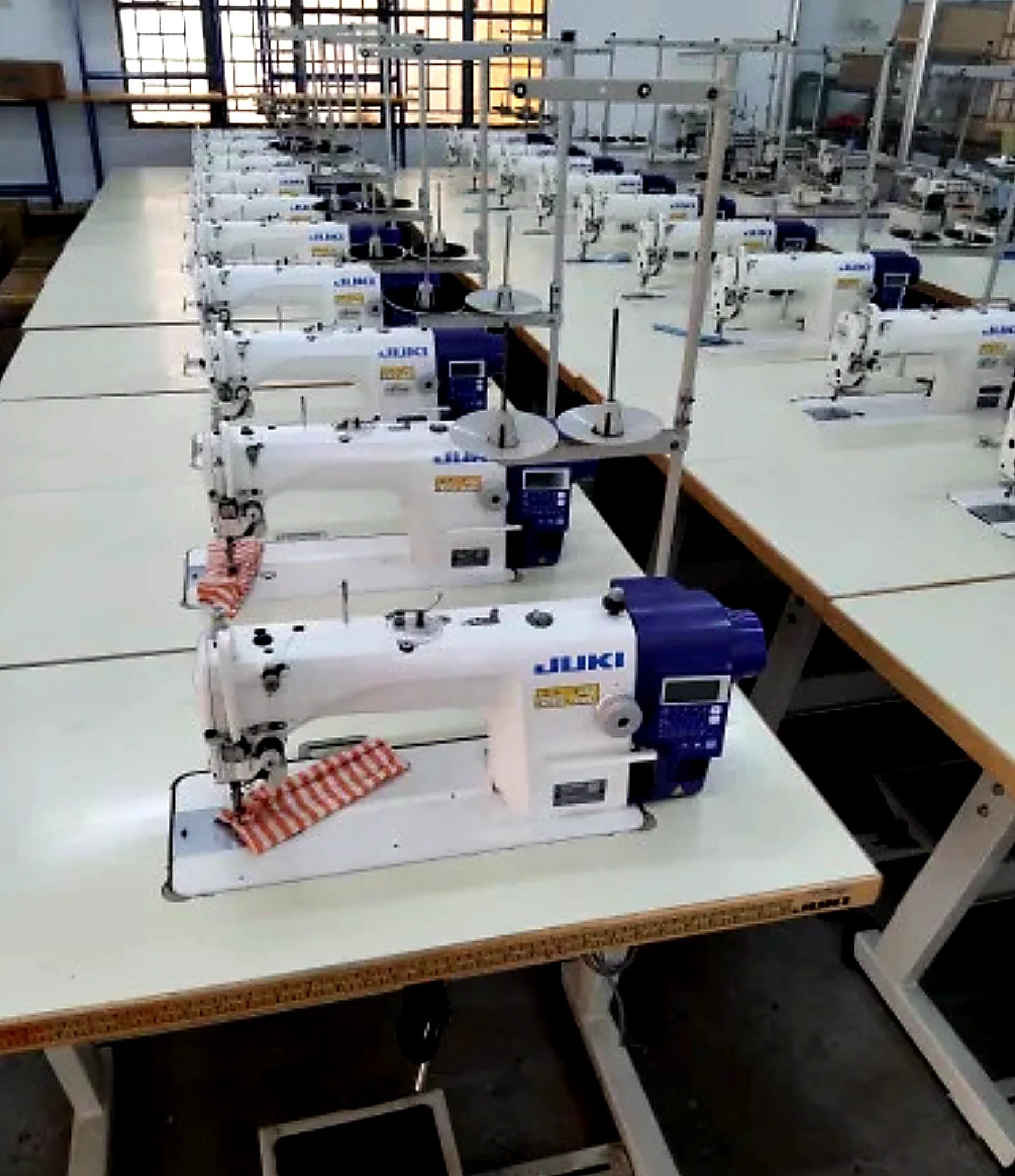
Factory Spotlight: JUKI-Equipped Precision Lines
Our main manufacturing floor in Udyog Vihar, Gurgaon houses state-of-the-art JUKI industrial sewing machines, automated bar-tacking units, and specialized lockstitch machines. Combined with our 50+ master tailors and quality inspectors, this machinery allows us to maintain a monthly capacity of 20,000+ export-quality garments while adhering to ISO 9001:2015 quality protocols.
Get Catalog5. Frequently Asked Questions (FAQ) for Apparel Sourcing Buyers
Below are answers to the most critical technical and commercial questions global apparel buyers ask when evaluating private label manufacturing partners:
At Vihaan International, we cater to both growing fashion brands and enterprise organizations. Our standard MOQ for fashion apparel (women's western wear, streetwear, casual wear) starts at 200 pieces per style/colorway. For corporate uniform programs and custom institutional orders, our baseline MOQ is 500 pieces. We also offer multi-size assortments within these MOQs to ensure balanced retail inventory.
You can submit your designs as complete CAD tech packs, vector flat sketches, or physical reference samples. A comprehensive tech pack should include vector flat drawings, artwork dimensions/placements, Pantone color codes, fabric composition preferences, and a graded measurement spec sheet. If you do not have a completed tech pack, our in-house technical design team can build one from your physical sample or visual reference photos.
We prioritize client confidentiality. Before receiving any technical files or design concepts, we sign a legally binding Non-Disclosure Agreement (NDA). All pattern files, custom print artwork, brand labels, and sample prototypes are stored in an encrypted database and never shared, showcased, or re-used for third-party clients.
Our facility operates under an ISO 9001:2015 Quality Management System using a 5-stage inline inspection workflow: raw fabric inspection, CAD cutting accuracy check, inline stitching verification (every 3rd operation), post-embroidery/print audit, and final AQL 2.5 (Acceptable Quality Limit) random sampling prior to carton packing. Third-party inspection agencies (e.g., SGS, Intertek, Bureau Veritas) are welcomed at our factory.
As an IEC-registered and DGFT-compliant manufacturer, we offer full flexibility across standard international Incoterms including FOB (Free on Board - Nhava Sheva / Delhi Air Cargo), CIF (Cost, Insurance & Freight), and DDP (Delivered Duty Paid) direct to your warehouse door in the USA, UK, EU, Canada, or Middle East. We manage export documentation, customs clearance, and origin certificates.
Yes. We offer complete private label trim packages: custom damask woven neck labels, printed satin care tags, FSC-certified paper hangtags, custom polybags with barcode stickers, metal buttons with laser logos, and branded mailing boxes.
Sample development (Proto / Fit sample) takes 7 to 10 working days upon fabric approval. Once the Pre-Production (PP) sample is approved by your team, bulk garment production takes 15 to 25 calendar days depending on order volume and fabric customization complexity.
We support both CMT (Cut, Make, Trim) contracts where clients supply raw fabric, and full FPP (Full Package Production) contracts where we source, custom-dye, test, and manufacture raw materials through our certified mill partners.
6. Enterprise Advantage: Why Vihaan International is India's Premier Apparel Partner
Founded in 2020 and headquartered at 116 MA Tower, Udyog Vihar, Phase 4, Gurgaon, Vihaan International has grown into a trusted private label clothing manufacturer and exporter. Our corporate background and infrastructure provide buyers with key strategic advantages:
ISO 9001:2015 Certified System
Our quality management system (Certificate E20260953327) guarantees rigorous process control from yarn inspection through final garment dispatch.
20,000+ Units Monthly Production Capacity
Our Gurgaon factory operates specialized production lines designed for quick-turnaround boutique collections and high-volume corporate uniform contracts.
Proven Export Track Record
We export to over 15 countries, including the USA, United Kingdom, Canada, France, Germany, UAE, and Australia, handling all customs documentation in-house.
Dedicated Account Managers & Fast Response
Every account is assigned a dedicated apparel merchandiser who provides daily production updates, fabric swatches, and real-time video audits via WhatsApp or email.
Whether you are launching a private label D2C apparel line, expanding a retail chain's seasonal offering, or outfitting a multinational enterprise with custom corporate uniforms, Vihaan International provides the technical expertise, modern factory floor, and transparent supply chain required for long-term growth.
Ready to Scale Your Private Label Apparel Line?
Download our comprehensive Private Label Product Catalog & Technical Fabric Specification Guide. Request custom fabric swatches or schedule a 1-on-1 virtual factory tour with our senior garment engineering team.