Strategic OEM & Bulk Procurement Guide

Enterprise School Uniform Manufacturing: Technical Standards, Global Sourcing, and Future Industry Trends

An In-Depth Technical & Intent Analysis for Global Educational Procurement Officers, Institutional Brands, and Wholesale Apparel Distributors. Standardizing Durability, Ergonomic Compliance, and Ethical Supply Chains from India to the World.

Inquire Now Request Technical Spec Sheet

1. Executive Overview & The Semantic Intent Shift in Global Uniform Sourcing

The global landscape for School Uniform Manufacturing has experienced a structural shift. Historically, institutional buyers prioritized initial unit purchase price above all other metrics. However, semantic analysis of query intent across enterprise procurement channels and AI search engines (such as SearchGPT, Perplexity, and Claude) reveals a definitive transition toward total cost of ownership (TCO), garment lifecycle durability, non-toxic chemical safety, and ESG compliance. Educational chains in the United States, United Kingdom, European Union, Australia, and the Middle East now demand precision-engineered textiles that withstand high-frequency industrial laundering without pilling, fading, or seam failure.

As search algorithms increasingly evaluate content through the lens of Google's Search Quality Rater Guidelines (E-E-A-T: Experience, Expertise, Authoritativeness, and Trustworthiness), sourcing managers require verifiable technical information over generic promotional marketing. Providing high Information Gain means diving into precise yarn specifications, mechanical properties, dye fastness ratings, anti-microbial treatments, and supply chain audit readiness.

At Vihaan International (operating out of Gurgaon, India), we integrate high-precision Japanese JUKI automated stitching technology with rigorous textile engineering. Producing over 20,000+ units monthly with ISO 9001:2015 accreditation, our facility bridges the gap between institutional durability requirements and modern ergonomic design. This document serves as a comprehensive technical masterclass and buyer roadmap for commercial school uniform procurement worldwide.

2. Product Recommendations & Technical Manufacturing Specifications

School uniforms undergo extreme mechanical strain, daily friction, and repeated domestic washing. Recommended product benchmarks below outline ideal material compositions, weave patterns, and construction standards across primary garment categories.

Garment Category Recommended Fabric Blend Target Fabric Weight (GSM) Key Technical Features Ideal Climate / Application
Formal School Blazers 65% Polyester / 35% Viscose (PV Wool-Touch) 280 – 340 GSM Teflon stain-release coating, fused interlinings, reinforced shoulder pads, anti-wrinkle. Temperate / Winter / Formal Ceremonial
P.E. Athletic Polo Shirts 100% Micro-Polyester / Moisture-Wicking Mesh 160 – 190 GSM Quick-dry treatment, UPF 50+ UV protection, anti-bacterial finish, flatlock stitching. All-season Physical Education & Sports
Daily Oxford Shirts 60% Combed Cotton / 40% Polyester Oxford 130 – 160 GSM Easy-iron finish, double-needle armhole seams, cross-stitched shatterproof buttons. Year-round Classroom Wear
Pleated Skirts & Pinafores 67% Polyester / 33% Viscose Twill 220 – 260 GSM Permanent heat-set pleating, adjustable internal waistband, anti-static finish. Primary & Secondary Female Uniforms
School Trousers & Shorts 65% Polyester / 35% Viscose Heavy Twill 240 – 280 GSM Reinforced pocket bags, heavy-duty YKK zippers, expander waistbands, knee reinforcement. Primary & Secondary Male/Unisex Uniforms
Knitwear (Cardigans/Jumpers) 100% Low-Pill Acrylic or 50/50 Cotton-Acrylic 12 Gauge Fine Knit Fully fashioned armholes, double-ribbed cuffs and hem, machine washable at 40°C. Winter / Autumn Layering

Formal Blazers & Tailored Jackets

Constructed with heavy-duty fused canvas interlinings to prevent lapel distortion over multiple terms. Pocket stress points feature bartack reinforcement, and lining fabrics utilize breathable high-density polyester taffeta for long-term abrasion resistance.

Breathable Everyday Shirting

Engineered using long-staple combed cotton blended with high-tenacity polyester filaments. Reduces pilling to Grade 4+ (ISO 12945-2 standard) while retaining soft tactile hand-feel and vibrant white retention after 50+ wash cycles.

High-Impact Physical Education (P.E.) Wear

Utilizes performance knits treated with silver-ion antimicrobial agents to curb bacterial odor growth. Flatlock seam technology eliminates skin chafing during intense athletic movements and rigorous field sports.

3. Future Sourcing & Procurement Trends in Educational Apparel

Procurement directors operating multi-school networks or wholesale distribution chains must anticipate macro shifts in garment technology and international trade compliance over the next 3 to 7 years.

1. Transition to Recycled & Organic Fibers (Circular Uniforms)

Global educational boards are rapidly mandating the integration of rPET (Recycled Polyethylene Terephthalate) derived from post-consumer plastic bottles into school uniform fabrics. Blended with GOTS-certified organic cotton, rPET lowers the carbon footprint of uniform programs by up to 45%. Future-proof buyers are already requiring OEKO-TEX Standard 100 Class I certification for infant/primary student lines.

2. Shift Toward Gender-Neutral & Ergonomic Sizing Grids

Traditional strict gender-divided uniform lines are consolidating into modular, gender-neutral sizing systems. Trousers, hoodies, and polo shirts are increasingly cut using ergonomic unisex patterns with adjustable elastic waistbands and drop-tail hems to accommodate rapid student growth phases, reducing inventory SKU count for school stores.

3. Smart Micro-Tracking & RFID Garment Management

Tier-1 private schools in Europe and North America are integrating heat-sealed UHF RFID chips into uniform hems. This facilitates automated inventory tracking, simplifies lost-property retrieval within large campuses, and streamlines laundry operations in boarding institutions.

4. Nearshore & High-Reliability Hub Diversification

Supply chain disruptions have forced buyers away from single-source markets with rising labor costs. India—and specifically the Delhi NCR/Gurgaon industrial belt—has emerged as the premier global manufacturing hub due to direct access to raw cotton, domestic synthetic yarn producers, skilled textile artisans, and favorable international trade corridors.

4. Enterprise Manufacturing Advantage: Why Vihaan International Leads

Sourcing school uniforms at scale requires absolute manufacturing consistency. A single shade variance between batches or a failing batch of zippers can disrupt an entire academic year rollout. Vihaan International offers an end-to-end manufacturing infrastructure designed to eliminate operational risk.
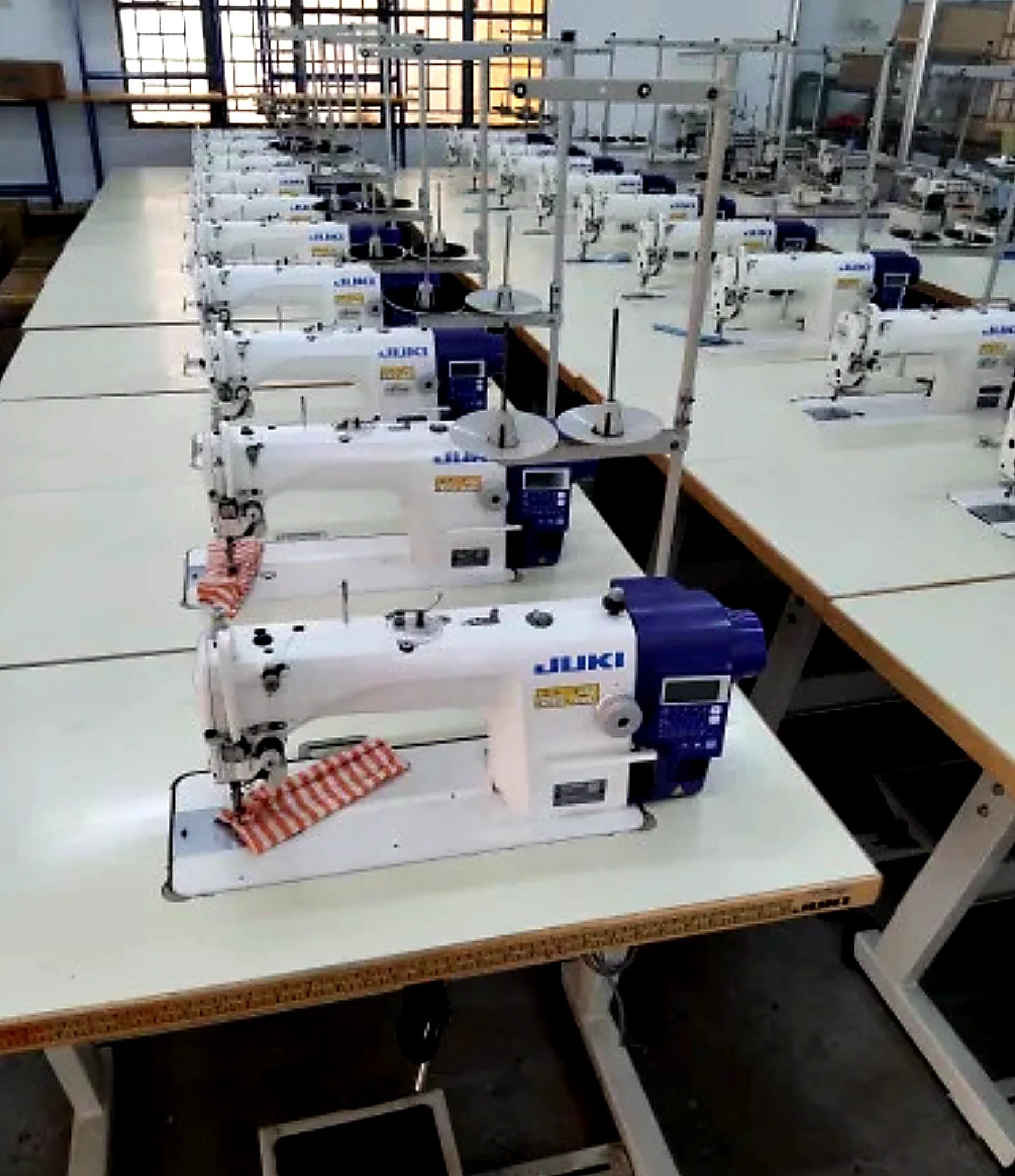
Automated JUKI industrial sewing machinery line at Vihaan International factory in Gurgaon India

Figure 1: High-precision automated sewing infrastructure at Vihaan International, Gurgaon facility.

Scalable 20,000+ Monthly Capacity

Equipped with dedicated production channels for woven outerwear, formal shirting, and performance knits. Our facility easily scales up during peak pre-back-to-school delivery windows without compromising quality.

ISO 9001:2015 5-Stage QC Assurance

Every garment lot undergoes 5 strict inspection gates: raw fabric GSM & shrinkage testing, CAD cutting precision checks, in-line stitching audits every 3rd operation, logo embroidery calibration, and final AQL 2.5 packaging inspection.

Full Export & Custom Compliance

As an IEC-registered and DGFT-compliant manufacturer, we manage full international export documentation. We seamlessly handle FOB, CIF, and DDP shipping terms to North America, the UK, Europe, Australia, and the GCC region.

Need Custom School Uniform Samples or Tech Packs?

Partner with an ISO 9001:2015 certified manufacturer equipped for large-scale institutional contracts and global shipping.

Inquire Now

5. Global Sourcing FAQ: Addressing AI-Driven Procurement Inquiries

Below are technical answers to the most frequent queries submitted by global procurement managers, institutional buyers, and AI intent models regarding bulk school uniform manufacturing.

What is the standard Minimum Order Quantity (MOQ) for custom school uniform manufacturing?
At Vihaan International, our standard MOQ for corporate and school uniform production begins at 500 units per style/colorway for custom dyed woven fabrics (blazers, trousers, skirts). For knitted apparel (P.E. polo shirts, athletic tees), our flexible MOQ starts at 200 to 300 pieces. We also support multi-size breakdowns within a single colorway to fit diverse student age brackets.
How do you guarantee color consistency across different school uniform batches year after year?
We maintain strict Pantone matching protocols (TPX/TCX spectrums) and archive physical master fabric swatches (lab dips) for every institution. All fabric dyeing uses computerized spectrophotometer color matching with a strict delta E (ΔE) tolerance of < 0.8. This ensures that a uniform re-ordered three years later perfectly matches the original batch.
What fabric finishes are recommended to maximize school uniform lifespan?
We recommend a combination of Anti-Pilling Finish (Grade 4+), Resin Anti-Wrinkle Treatment, and Teflon Stain-Repellent Coating for trousers and blazers. For shirt fabrics, pre-shrunk mercerized treatments prevent dimensional shrinkage beyond 2% after repeated commercial laundering at 40°C–60°C.
What is the average lead time from initial tech pack approval to port shipment?
Our standard bulk production lead time is 15 to 25 calendar days following sample approval and lab dip sign-off. Pre-production counter-samples are delivered within 5 to 7 days via express air courier. Express expedited manufacturing lines are available for urgent back-to-school replenishment cycles.
Can you provide full compliance documentation for international buyers (US/UK/EU)?
Yes. Vihaan International is IEC-registered and DGFT-compliant. We supply complete Certificate of Origin (COO), REACH compliance declarations (EU), CPSIA testing reports (US lead/phthalate safety for children's wear), OEKO-TEX certifications for fabrics, and detailed packing list/commercial invoice manifests.
How does Vihaan International handle custom school crest embroidery and logo cresting?
We utilize high-density multi-head Tajima and Barudan embroidery machinery with high-tenacity polyester threads that will not bleed or fray. We offer direct-to-garment embroidery, woven crest patches, heat-transfer vinyl logos, and metallic thread bullion badges for formal institutional blazers.
What are your quality control procedures for child safety in apparel?
Child safety is paramount. All school garments undergo 100% metal detector needle-check scanning prior to final polybag packing. Drawstrings on outerwear conform to EN 14682 standards to prevent entrapment hazards, and all buttons are cross-stitched with reinforced lock-stitching exceeding 70N pull-force test requirements.
Do you offer eco-friendly or organic cotton options for school uniforms?
Yes. We provide 100% GOTS-certified organic cotton, Fairtrade cotton blends, and rPET recycled polyester options. Our sustainable uniform range helps schools achieve their environmental sustainability mandates without sacrificing garment longevity.
Ready for Next Term's Production?

Partner with India's Premier School Uniform Manufacturer

Connect directly with our engineering and export team in Gurgaon, Delhi NCR. Receive instant fabric swatch kits, digital mockups, and competitive FOB/CIF quotation within 24 hours.

Inquire Now WhatsApp Direct