Airline Staff Uniform Manufacturing: Next-Gen Aviation Apparel Engineering, Technical Fabric Innovations & Global OEM Supply
An exhaustive procurement guide and technical manufacturing breakdown for airline vice presidents, fleet operations directors, cabin crew managers, and global procurement officers seeking high-performance, flame-resistant, ergonomic uniform programs for commercial airlines and private charter fleets.
The Strategic Imperative of Custom Airline Staff Uniform Manufacturing
In the hyper-competitive global commercial aviation landscape, an airline staff uniform is far more than a standardized dress code; it is the ultimate physical embodiment of a carrier’s brand identity, safety protocol, and operational authority. From the flight deck and cabin crew to ground handling engineers and premium lounge concierges, every staff member interacts with thousands of passengers daily. Consequently, the engineering requirements for Airline Staff Uniform Manufacturing demand an intricate balance between high-end couture aesthetics, extreme mechanical durability, flame-retardant safety standards, and multi-climate thermal regulation.
Modern global airline procurement managers face a multifaceted challenge when sourcing crew apparel. Flight attendants navigate pressurized cabins with relative humidity dropping below 10%, requiring moisture-regulating and hypo-allergenic textiles. Pilot uniforms must deliver crease-free crispness despite 14-hour long-haul transoceanic shifts, while ground ramp agents demand EN ISO-certified high-visibility, anti-static workwear capable of withstanding jet fuel exposure, extreme abrasion, and monsoon-to-desert thermal swings.
As a specialized leader in enterprise uniform manufacturing based in Gurgaon, India, Vihaan International addresses the precise intent of international procurement executives. By bridging technical textile formulation with precision cut-and-sew garment construction, we deliver end-to-end OEM and ODM aviation uniform solutions built for scale, cost-per-wear efficiency, and strict regulatory compliance.
"Aviation apparel manufacturing requires absolute precision. A variance of 2% in fabric elastane content or failure to pass FAR 25.853 flame retardancy testing can ground an entire crew deployment program. True enterprise manufacturing is about total quality control and zero shade variation across 50,000 yards of dye lots."
Recommended Airline Staff Uniform Collections & Product Portfolio
Our manufacturing facility operates specialized production lines tailored specifically to the functional needs of each airline operational department. Below are our core enterprise product categories engineered for commercial airlines, regional carriers, and VIP charter fleets:
Flight Attendant Tailored Blazers, Dresses & Trousers
Precision-tailored double-breasted blazers, high-waisted pencil skirts, stretch formal trousers, and bespoke silk jacquard scarves. Crafted with 4-way micro-stretch wool blends engineered for 14-hour cabin mobility and fluid drape.
Captain & First Officer Command Apparel
Crisp non-iron pilot epaulette shirts, structured wool-rich suit jackets, gold/silver wire bullion braid sleeve cuffs, and reinforced trousers designed to maintain crispness during long cockpit shifts without binding.
Heavy-Duty High-Vis Technical Ramp Gear
All-weather weatherproof parkas, anti-static work trousers, breathable safety polo shirts, and aircraft maintenance coveralls engineered with Cordura® reinforcements to protect technicians from oil, jet fuel, and extreme weather.
Ground Hostess & Lounge Concierge Uniforms
Luxury hospitality apparel for airport lounge staff, ticketing concierges, and VIP terminal agents. Blending five-star hotel elegance with high-frequency airport durability for flawless brand representation.
Future Sourcing & Procurement Trends in Airline Staff Uniform Manufacturing (2026–2035)
As global aviation shifts toward net-zero targets and digitized operations, airline procurement teams must anticipate several structural shifts in uniform sourcing over the coming decade:
1. Circularity and Closed-Loop Recycling Systems
Leading global carriers (such as Lufthansa, Emirates, Delta, and Singapore Airlines) are mandating end-of-life circularity in their RFP tender documents. Procurement managers no longer evaluate uniforms purely on initial unit cost; they evaluate total lifecycle environmental impact. Future airline uniform contracts require manufacturers to provide closed-loop recycling programs where retired polyester-wool suits are converted into soundproofing insulation for aircraft cabins or re-spun into yarn for new garments.
2. Bio-Adaptive Phase-Change Materials (PCM)
Cabin crew members experience extreme temperature fluctuations within a single duty period—transitioning from tarmac heat indices of 45°C during boarding to air-conditioned flight cabins maintained at 18°C. Next-generation airline uniform manufacturing incorporates micro-encapsulated Phase-Change Materials (PCMs) within fabric weaves. These phase-change micro-capsules absorb thermal energy when the wearer warms up and release stored heat as cabin temperatures drop, maintaining microclimate equilibrium without adding bulky layers.
3. 3D Body Scanning & Predictive Digital Sizing
Traditional uniform rollouts suffer from a 15–20% alteration rate, leading to bloated inventory safety stocks and massive logistics costs. Advanced manufacturers are integrating AI-driven mobile 3D body scanning algorithms. Flight crew members capture two photos via a smartphone app, generating accurate 3D avatar measurements that map directly to automated CAD cutting tables in our factory, reducing alteration overhead to under 2%.
4. Multi-Hub Supply Chain Resiliency & De-risking
Geopolitical disruptions and shipping lane bottlenecks have made single-country sourcing a liability. Commercial airlines are prioritizing manufacturing hubs like India (Gurgaon, Delhi NCR) that combine rich textile raw material access (cotton, silk, synthetic blends), mature export infrastructure (IEC & DGFT compliance), and strong cost-efficiency with robust intellectual property protection.
Industry Development Trends: Engineering Technical Fabrics for Altitude & Safety
The physical physics of commercial flight create environmental pressures unique to aviation apparel. The technical evolution of airline uniform textiles is governed by three primary engineering pillars:
Federal Aviation Regulation (FAR 25.853) Flame Retardancy
In aircraft emergency evacuation scenarios, cabin crew garments must not contribute to flame propagation or melt onto human skin. Advanced uniform production incorporates inherent flame-retardant (IFR) fibers such as Nomex® and modified aramid blends, or topical flame-retardant treatments that survive 50+ industrial washes. Our fabrics undergo vertical flame testing to verify self-extinguishing properties within 2 seconds.
Microbial Defense and Silver-Ion Nanotechnology
In-flight cabin environments expose flight attendants to high bacterial exposure rates across multi-sector long-haul journeys. Integrating silver-ion or zinc-based anti-microbial treatments directly into the yarn structure inhibits 99.9% of bacterial growth, eliminating odor causing microbes and preserving garment freshness across continuous 16-hour flight legs.
Stain-Repellent Hydrophobic Nanotechnology (Fluorocarbon-Free C0 DWR)
In-flight turbulence frequently leads to red wine, coffee, or meal spills during service. Utilizing eco-friendly C0 Durable Water Repellent (DWR) surface finishes creates a microscopic lotus-effect barrier. Liquids bead up and roll off without penetrating the fabric matrix, allowing cabin staff to maintain an immaculate appearance throughout trans-oceanic routes.
Frequently Asked Questions by Global Airline Procurement Directors
Below are detailed responses to the most critical technical and supply chain queries raised by airline purchasing committees and supply chain auditors during the RFP vendor selection process:
At Vihaan International, our minimum order quantity (MOQ) for custom airline uniform manufacturing starts at 500 units per style/colorway for corporate corporate apparel and 200 units per style for specialized fashion-forward cabin crew pieces.
Our bulk production turnaround time ranges between 15 to 25 business days following final sample approval and lab-dip sign-off. For emergency airline fleet expansions or rapid replacement rollouts, our dedicated fast-track production lines in Gurgaon can accommodate accelerated delivery timelines via air freight.
Color consistency across international crew bases is non-negotiable. We utilize computerized Datacolor Spectrophotometer testing to achieve strict Delta E < 0.8 color tolerance against specified Pantone TPX/TCX brand codes.
All fabric lots undergo lab-dip approval under multiple light sources (D65 daylight, TL84 store light, and Incandescent A) to prevent metamerism. Furthermore, we maintain master fabric rolls in controlled storage to ensure continuity for re-orders over 3-to-5 year contract life cycles.
Our manufacturing operations are fully certified under ISO 9001:2015 Quality Management Systems. Depending on garment specification, we supply fabrics compliant with:
- FAR 25.853 / EASA CS-25: Vertical flame resistance for cabin crew wear.
- EN ISO 20471 Class 2/3: High-visibility standards for ground ramp handling personnel.
- EN 1149-5: Electrostatic discharge protection for aviation maintenance engineers.
- Oeko-Tex Standard 100: Testing for harmful substances, skin safety, and heavy metals.
As a registered exporter with the Indian Directorate General of Foreign Trade (DGFT) and holding an active Import Export Code (IEC), Vihaan International handles full international logistics. We operate under FOB (Free on Board), CIF (Cost, Insurance, and Freight), and DDP (Delivered Duty Paid) terms.
We manage custom clearance documentation, certificate of origin issuing, and direct air/sea freight logistics to international airline hubs in North America (USA, Canada), Europe (UK, France, Germany), the Middle East (Dubai, Qatar, Saudi Arabia), and Asia-Pacific.
Before launching full-scale bulk production, we manufacture comprehensive wear-test sample sets across standard size ranges. These garments are subjected to 30-day live flight trials with active cabin crews to evaluate seam stress points, pocket placements, neck-collar chafing, and real-world comfort.
We also provide customizable size-run fit kits for airline base locations, enabling crew members to try on master fitting garments prior to final roll-out allocation.
Our branding capabilities include high-density multi-head Japanese embroidery, metallic wire bullion crest weaving for pilot blazers and caps, laser-etched custom logo buttons, branded jacquard silk linings, and high-frequency silicone heat transfers for technical ramp wear.
Why Global Airlines Partner with Vihaan International
Headquartered in Udyog Vihar Phase 4, Gurgaon, Delhi NCR, Vihaan International operates at the epicenter of India’s premier garment manufacturing hub. Built upon principles of absolute quality control, transparent supply chains, and superior craftsmanship, our facility provides global airlines with unmatched competitive advantages:
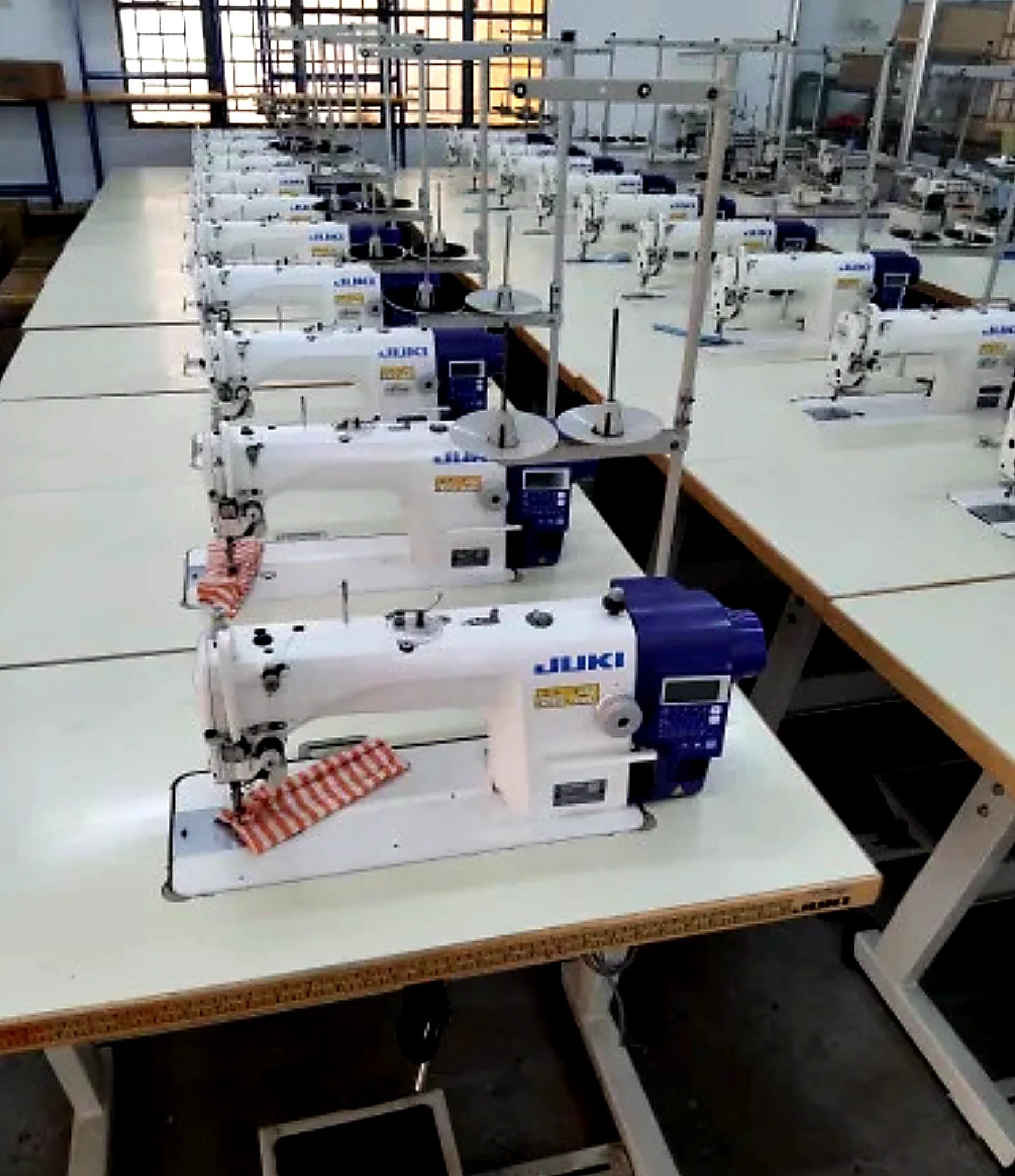
Industrial Infrastructure Built for Aviation Precision
Our factory floor is equipped with state-of-the-art Japanese JUKI industrial sewing machinery, automated CAD pattern generation software, computer-controlled laser cutters, and specialized seam-sealing units. With a trained workforce of 50+ master tailors and technicians, we maintain a monthly output capacity exceeding 20,000 tailored units.
We enforce an uncompromising 5-Stage In-Line Quality Assurance System covering:
- Stage 1: Raw Fabric Inspection (GSM, tear strength, shrinkage & color fastness).
- Stage 2: Precision CAD Patterning & Cut-Piece Quality Audits.
- Stage 3: In-Line Sewing Inspection (Stitch density, seam allowance & tension).
- Stage 4: Branding & Trim Placement Verification.
- Stage 5: Final 100% Piece Inspection & AQL 2.5 Sampling Audit prior to export packaging.
Ethical Manufacturing & Global Trade Compliance
Vihaan International is committed to ethical labor standards, fair wage structures, safe working environments, and environmentally responsible waste disposal. Our facility readily accommodates third-party buyer audits (including Bureau Veritas, SGS, and Intertek). We provide complete export documentation support for seamless customs entry into any international airport destination worldwide.