
Strategic Procurement Analysis: Private Label Denim Manufacturing in China
The global denim apparel sector is undergoing a profound paradigm shift. Procurement directors, brand founders, and apparel buyers sourcing from international manufacturing hubs require more than transactional factory listings. To achieve competitive market positioning in 2026 and beyond, sourcing executives must evaluate OEM (Original Equipment Manufacturer) and ODM (Original Design Manufacturer) partners based on raw cotton traceability, mill-level fabric engineering, sustainable wash chemistry, and strict compliance with international quality standards.
China remains the world's most sophisticated ecosystem for private label denim jacket production. By combining deep vertical integration—from ring-spun cotton spinning and indigo vat dyeing to automated computer-aided design (CAD) cutting, laser distressing, and zero-liquid discharge (ZLD) wet processing—leading Chinese apparel manufacturers deliver unmatched technical consistency. This comprehensive industry whitepaper provides operational benchmarks, material engineering standards, wash specifications, cost breakdown frameworks, and risk mitigation protocols designed specifically for B2B procurement decision-makers.
1. Technical Specifications & Material Engineering Matrix
A premium denim jacket’s longevity, hand-feel, structural silhouette, and fade characteristics depend fundamentally on the yarn geometry and weave structure selected at the textile mill level. When drafting a tech pack for custom private label denim jackets, technical buyers must explicitly define weight (oz/yd²), warp/weft yarn composition, and selvedge structural characteristics.
| Denim Category | Fabric Weight | Yarn & Weave Structure | Recommended Application | Shrinkage Tolerance |
|---|---|---|---|---|
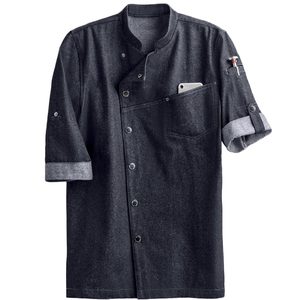
| Lightweight Workwear Denim | 8.5 oz – 10.5 oz | Open-end cotton blend / 2x1 Right-Hand Twill | Hospitality chef jackets, lightweight layering, spring utility shirts | ≤ 2.5% (Sanforized) |
| Standard Commercial Denim | 11.0 oz – 13.5 oz | Ring-Spun Warp + Slub Weft / 3x1 RHT | Classic trucker jackets, retail fashion lines, corporate uniforms | ≤ 3.0% (Sanforized) |
| Heavyweight Heritage Selvedge | 14.0 oz – 16.5 oz | Combed Ring-Spun Cotton / Vintage Shuttle Loom Selvedge | Boutique luxury outerwear, heavy workwear, raw selvedge jackets | ≤ 1.5% (Mercerized/Sanforized) |
| Performance Stretch Denim | 10.0 oz – 12.0 oz | Cotton/Polyester/Elastane (DualFX Core) | Active corporate apparel, slim-fit fashion, service staff outerwear | ≤ 4.0% (Heat Set) |
Yarn Quality & Ring-Spun Advantages: Ring-spun cotton yarns deliver superior tensile strength and surface texture compared to budget open-end yarns. For premium private label denim collections, utilizing cross-hatch slub yarns creates authentic vintage fading patterns after stone washing or laser treatments.
2. Industrial Finishing, Wash Engineering & Sustainable Chemistry
The wash process defines up to 40% of a denim jacket's visual identity and total FOB cost. Modern Chinese denim facilities have shifted from legacy chemical-heavy washing toward sustainable, automated wet and dry processing technologies.
Ozone Oxidation & E-Flow
Ozone gas bleaching replaces hazardous sodium hypochlorite, reducing water consumption by up to 80% while achieving clean indigo contrast and eliminating chemical odors. Nanobubble E-Flow technology applies softening agents with minimal fluid volume.
3D Laser Whisker & Abrasion
Computerized 3D laser systems replicate natural wear patterns, whiskers, and honeycombs with sub-millimeter precision. Laser processing guarantees 100% batch-to-batch consistency across thousands of bulk jackets without manual sanding variance.
Enzyme Stone Washing
Neutral cellulase enzymes hydrolyze surface cotton fibers, releasing trapped indigo pigment to create soft hand-feel and authentic salt-and-pepper grain without damaging fabric tensile strength or seam integrity.
Factory Operations, Capacity & Quality Control Systems
Partnering with an established apparel manufacturer ensures enterprise security, seamless bulk fulfillment, and full global export compliance. Integrating modern industrial engineering with strict quality control frameworks guarantees that every shipment meets stringent buyer standards.
Production Infrastructure & Lead Times
- Monthly Output Capacity: 20,000+ units across specialized jacket and workwear assembly lines.
- Turnaround Speed: Prototyping and wash lab dips completed within 7 days; bulk delivery in 15–25 days.
- CAD & Pattern Studio: Computerized grading system ensuring uniform fit scaling from XS to 5XL across European and American size charts.
- Custom Branding Solutions: In-house embroidery, custom branded shank buttons, copper rivets, woven chest labels, and embossed genuine/vegan leather back patches.
5-Stage In-Line QC & International Compliance
- Stage 1 - Fabric Inspection: GSM measurement, crocking/colorfastness test, and shrinkage verification on raw rolls.
- Stage 2 - CAD Cutting QC: Precision pattern match checking and notch alignment before stitching.
- Stage 3 - In-Line Seam Inspection: Stitch density (SPI), heavy-duty twin-needle flat-felled seam checks every 3 operations.
- Stage 4 - Post-Wash Physical Testing: Tensile strength, hardware pull tests (shank buttons & rivets), wash contrast verification.
- Stage 5 - Final AQL 2.5 Audit: ISO 9001:2015 compliant random sampling, thread trimming, polybag sealing, and export carton packaging audit.
Global Trade & Export Compliance: Fully accredited with Import Export Code (IEC) registration and DGFT compliance. Experienced in managing cross-border logistics including FOB, CIF, and DDP (Delivered Duty Paid) shipping to North America, Europe, Australia, and the Middle East.
3. OEM/ODM Private Label Customization Workflow
Executing a successful private label denim collection requires a structured development lifecycle. Our streamlined OEM/ODM workflow eliminates technical misalignment between tech packs and finished factory samples.
Tech Pack & Spec Analysis
Review measurement specs, stitch density, fabric weight, button finish, and wash swatches or target reference images.
Sample & Wash Lab Dip
Develop physical proto-samples, execute initial wash trials, and send fit samples for client review within 7 days.
PPS Approval & Pre-Bulk
Finalize Pre-Production Samples (PPS) with full custom trim, branded hardware, hangtags, and packaging layout.
Bulk & AQL 2.5 Export
Execute CAD cutting, assembly, industrial washing, 100% thread trimming, AQL 2.5 final inspection, and global shipment.
4. 2026–2030 Global Denim Sourcing & Procurement Trends
Supply chain sustainability, circular economic mandates, and AI-driven inventory management are reshaping how global apparel brands procure denim jackets. Buyers who adapt early to these emerging shifts will gain significant margin advantages and mitigate compliance risks.
Circular Textiles & Recycled Fiber Integration
European and North American regulatory frameworks (such as the EU Ecodesign for Sustainable Products Regulation) now encourage high percentages of Post-Consumer Recycled (PCR) cotton and Global Recycled Standard (GRS) certified fibers. Leading Chinese denim mills have perfected 20%–30% PCR cotton blending while preserving the high tear strength required for classic denim outerwear.
Digital Twin 3D Sampling & Inventory Speed
Replacing physical sample iterations with 3D digital apparel simulation software (CLO 3D / Browzwear) reduces pre-production lead times by up to 60%. Brand buyers can evaluate garment drape, wash patterns, and pocket placements virtually, cutting carbon footprints and accelerating time-to-market.
Hybrid Workwear & Utility Jacket Evolution
The boundary between traditional corporate workwear and lifestyle streetwear has blurred. Modern corporate clients are replacing standard polyester blazers with premium custom denim jackets featuring concealed utility pockets, fleece lining, and micro-embroidery logos for service staff, tech teams, and promotional campaigns.
Waterless & Zero-Liquid Discharge (ZLD) Washing
Environmental compliance has transitioned from a marketing asset to a non-negotiable procurement standard. China’s strict environmental regulations have forced top denim factories to install advanced ZLD water recycling plants that purify and reuse over 95% of industrial wash water.